


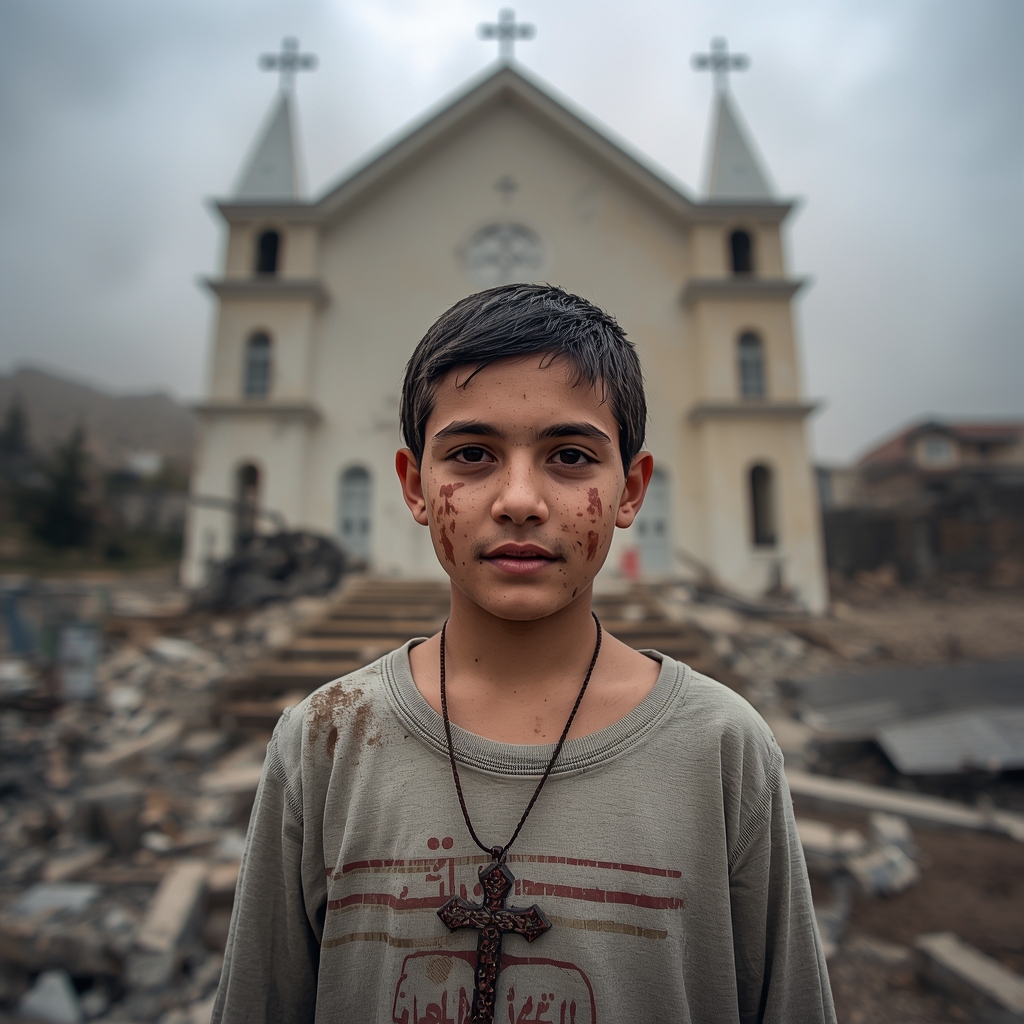
Prayers Under Fire: Lebanon’s Christians Observe Good Friday as Israeli Strikes Pound the South
For Lebanon’s Christian communities, this Holy Week carries a weight that no liturgy alone can bear.
The sound of airstrikes punctuating ancient prayers fills the air, and the smell of smoke replaces the incense that once rose.
Christians across Lebanon observed Good Friday, praying for peace. Israeli strikes and evacuation orders continued across the country. Al Jazeera reporters heard three loud blasts echoing across Beirut around sunset on Friday.
This time is crucial as many were marking the solemn day despite escalating hostilities.
Since hostilities erupted between Israel and Lebanon’s Iran-backed Hezbollah militant group, over 1,400 people have been killed in Lebanon. More than one million have been forced to flee their homes. Among those displaced from the war-torn south are thousands of Christians.
This is a severe humanitarian crisis, affecting communities and families.
Lebanon is home to the largest proportion of Christians of any nation in the Arab world, with Christians making up around a third of the country’s population of roughly 5.5 million people and belonging to 12 distinct Christian sects. They have maintained a strong presence across centuries of Byzantine, Arab, and Ottoman rule, and through plenty of modern-day crises. ABC News
This latest chapter, however, has tested even that enduring resilience.
“Today, You Understand What the Cross Means”
At St. Anthony Church in the Beirut suburb of Jdeideh, the Rev. Dori Fayyad used his Good Friday sermon to note the war’s toll on southern Lebanese Christians. The faithful recited prayers in Arabic and Syriac — a dialect of the Aramaic language spoken by Jesus.
The resilience of these communities is truly enduring. They have faced numerous challenges over the decades.
He told fully packed pews, with dozens more standing or crouching on the back stairs, “Today, you understand what the cross means, not as an idea, but because you are going through it.” Some wiped away tears as Fayyad named the southern churches one by one.
A priest in the southern Lebanese city of Tyre, where much of the Christian community has hunkered down, said he and his congregants were staying put “not out of stubbornness, but out of a sense of mission — to remain alongside their fellow faithful, as witnesses.” “A significant number of parishioners have been displaced or are absent,” he said. “Yet churches still open their doors. Prayers are still raised — even with fewer voices.” PBS
The Villages That Refused to Go
Israel has issued evacuation orders covering around 15% of Lebanese territory. They include around 9,000 Lebanese Christians living in a cluster of border towns, who told Reuters they were determined to stay despite the advancing military operations. Reuters
That determination has deep roots.
In border villages like Rmeish and Ein Ebel, residents organized community watch rotations in coordination with their local churches, whose bells are rung if any suspicious movement is detected. The apostolic nuncio to Lebanon was informed by a delegation representing residents of the southern Christian towns of Rmeish, Ein Ebel, Debel, and Alma al-Shaab that the inhabitants had made a final decision: they would not leave their land or their homes, regardless of the circumstances. EWTN
A group of priests gathered in the Christian town of Marjayoun and filmed themselves ringing church bells in defiance — a declaration that they would stay on their land. But days later, one of those priests, Father Pierre Rai, was killed by an artillery shell. Locals say it was fired by Israel; Israel says it came from Hezbollah. OPB
The viral footage of another priest, Father Najib Amil, captured the anguish of the moment. Standing in his village square surrounded by neighbors, he pleaded with the Lebanese Army not to withdraw. “Either we all die, and our village is lost,” he said, “or we all live, and our villages survive.” His neighbors erupted in applause. OPB Since he recorded that appeal, Lebanese army tanks withdrew as Israeli ones approached, leaving his village’s supply routes severed. He told journalists the village had food and fuel for only about 20 days. NPR
A Pattern Repeated Across Generations
This is not the first time Lebanon’s Christians have found themselves in this position — caught between a war they did not start and a homeland they will not surrender.
The 2006 War: During the 2006 war, residents of Christian villages in the south say many of their communities were hit by Israeli artillery fire and missile strikes, despite promises from Israel that they would not be attacked. The church of Mars Elias, one of the largest in the village of Alma al-Shaab, was damaged in that conflict. America Magazine Even then, many refused to leave. A local baker recalled that in 2006, residents used to gather in the church’s basement for shelter America Magazine — choosing proximity to their faith over flight.
The 2024 Conflict: By October 2024, Israel had issued evacuation notices to Christian villages near the border, yet many families were unable to leave due to financial hardship, with Lebanon’s economic crisis already leaving many facing hunger even before the fighting began. Premier Christian News One village, Deir Mimas, had a population of around 1,000 before the 2006 war; that conflict reduced it to about 350 residents. By the time of the 2024 fighting, only around 100 people remained. Christianity Today
2026 — The Breaking Point: Villagers in Alma al-Shaab had been uprooted before during the 2024 Israel-Hezbollah war, but this time they were adamant they would not leave, even as airstrikes came closer and closer. They huddled in their church for protection as Israeli warplanes pounded large swaths of southern and eastern Lebanon. PBS
What finally forced them out was the death of one of their own. A man stepped outside briefly on March 8 to tend to his garden — and was killed by an Israeli drone strike. His death prompted the remaining villagers, including his brother the local priest, to pack up their belongings. UNIFIL peacekeepers evacuated them to the northern suburbs of Beirut. Washington Times
“We wanted to stay, but it was always possible that one of us could be targeted or killed at any moment,” the Rev. Maroun Ghafari said from the Beirut suburb where he now preaches, standing beside a cardboard cutout of his church in Alma al-Shaab. “Everyone is tired, and we see that war brings nothing but destruction, death, and displacement.” Washington Times
“Not Our War” — But Their Land
In the mostly Christian town of Jezzine, one resident told reporters plainly: “This war has nothing to do with us Christians.” Across southern Lebanon, many Christians echo this sentiment.
They believe that Israel is targeting Shiite Muslim fighters, not them, and so they intend to remain in their homes.
“We don’t mind Hezbollah — they protect us in a way — but we stay cordial with them and each stay within our villages,” one resident said. Christians in the south feel caught in the crossfire; they neither oppose Hezbollah outright nor support its attacks on Israel. America Magazine
The U.S. ambassador to Lebanon said Washington had asked Israel to spare Christian villages from bombardment, and received a promise to that effect, conditional on Hezbollah members not infiltrating those villages. Some Christians say they received a pledge directly from Israel — via phone calls in Hebrew-accented Arabic. “We don’t want you to flee,” the caller said, according to a recording shared with journalists, “but we will strike if anyone in your village has any contact with Hezbollah. You will bear responsibility, and that would be a shame.” OPB
After receiving these calls, some Christian villages organized convoys to move displaced Shiites northward. The impossible arithmetic of survival in a sectarian war plays out in real time — hospitality balanced against self-preservation.
An Easter Without Home
These experiences reflect the ongoing struggles faced by the people of Lebanon.
One displaced woman, reminiscing about her village, said: “You miss the smell of home, the lovely traditions and customs, the sounds of the bells of three churches ringing. As much as we experience the Easter atmosphere here, it will never be as it is over there.” PBS
In his annual Easter homily, Patriarch Beshara al-Rai of Lebanon’s Maronite Church blamed both Hezbollah and Israel for the suffering wrought by the war. ABC News
Israeli attacks on Lebanon since March 2 have killed more than 1,400 people, including 126 children, and displaced over 1.2 million, according to Lebanese authorities. Al Jazeera A convoy carrying over 40 tons of aid led by the Vatican was supposed to reach the Christian village of Debel, but was canceled for what Lebanon’s Maronite Church cited as “security reasons.” ABC News
For Lebanon’s Christians — a people who have prayed through occupation, civil war, and invasion — Good Friday 2026 carried a meaning more literal than theological. The cross was the weight of a land they refuse to leave, and the grief of a home that may not be there when they return.
Reporting drawn from AP, NPR, Reuters, Al Jazeera, PBS NewsHour, and EWTN News.


